
You are standing at a fragrance counter, a strip of Eau de Parfum in each hand, and suddenly your nose gives up entirely. Both scents smell identical, yet you know they are not. This moment of sensory overload is something every fragrance lover has experienced, and it is far more common than the glossy adverts suggest. Choosing the wrong perfume is an expensive mistake, and with hundreds of new releases each year, the pressure to pick wisely has never been greater. This guide gives you a structured, expert-backed framework to compare perfumes with confidence, turning what feels like guesswork into a genuinely enjoyable process.
Table of Contents
- What you need before you start comparing perfumes
- How to analyse scent notes and perfume character
- Leverage online resources and community wisdom
- Deciding based on classification, season, and personal style
- Our perspective: why slow, mindful comparison leads to signature scents
- Discover your next favourite with Amoureé Parfums
- Frequently asked questions
Key Takeaways
| Point | Details |
|---|---|
| Preparation is key | Have testing materials, online access, and a fragrance journal ready before comparing perfumes. |
| Analyse notes and character | Break down and compare fragrances based on notes, structure, and reformulations for deeper understanding. |
| Use digital insights | Leverage community reviews and ratings from platforms like Parfumo for real-world perspectives. |
| Personal context matters | Always consider classification, season, occasion, and your unique style when making a final choice. |
| Mindful testing wins | Take your time and keep records to build confidence in finding your signature scent. |
What you need before you start comparing perfumes
Before you spray a single drop, clarity is everything. Ask yourself what you actually want from a new fragrance. Are you hunting for something with exceptional longevity that survives a full working day? Do you want a scent with bold sillage that announces your presence, or something intimate and close to the skin? Pinning down your priorities before you begin saves you from being seduced by a beautiful bottle that simply does not suit your life.
Here is what to gather before you start:
- Scent strips (blotters): Essential for initial impressions without committing to skin.
- Fragrance samples: Order or request samples so you can test on skin over time.
- A fragrance journal: A simple notebook where you record impressions, dates, and conditions.
- Access to comparison platforms: Parfumo and Fragrantica are the gold standard for structured analysis.
- A note wheel or fragrance family chart: Helps you identify and articulate what you are smelling.
Once you have your tools, use them systematically. Platforms like Parfumo allow you to do a side-by-side comparison of notes, ratings, classifications by type, season, and occasion, plus community scores for longevity and sillage. This is invaluable when you cannot smell both fragrances at the same time.
| Tool | Best used for | Cost |
|---|---|---|
| Parfumo | Side-by-side note and rating comparisons | Free |
| Fragrantica | Community reviews and note pyramids | Free |
| Scent strips | First impressions and initial elimination | Minimal |
| Fragrance journal | Tracking personal reactions over time | Minimal |
| Samples | Skin testing and wear testing | Low to moderate |
Good online shopping strategies also recommend ordering samples before committing to a full bottle, which pairs perfectly with the journalling approach.
Pro Tip: Use a fragrance note wheel to map your existing favourites. If you consistently love vetiver, sandalwood, and amber, you already know your base note preferences. This makes comparing new options far faster and more accurate.
How to analyse scent notes and perfume character
Every perfume tells a story in three acts. The top notes are the opening lines, vivid and fleeting, lasting roughly 15 to 30 minutes. The middle notes (also called the heart) form the core character of the fragrance and last for several hours. The base notes are the final chapter, the deep, lingering foundation that stays on your skin long after everything else has faded.
When you compare two perfumes, read their official note pyramids carefully. Here is how two hypothetical fragrances might look side by side:
| Layer | Fragrance A | Fragrance B |
|---|---|---|
| Top notes | Bergamot, pink pepper | Lemon, cardamom |
| Middle notes | Rose, iris, jasmine | Neroli, geranium, violet |
| Base notes | Sandalwood, musk, amber | Vetiver, oakmoss, cedar |
Fragrance A leans romantic and warm. Fragrance B reads greener and earthier. Even if both are labelled as florals, their characters are entirely different. Understanding fragrance notes at this level of detail transforms how you shop.
Here is a simple process for note analysis:
- Write down the full note pyramid for each perfume you are comparing.
- Identify shared notes and note where they diverge.
- Consider how the base notes will interact with your skin chemistry.
- Cross-reference with community data: the similarity score on Parfumo weights notes at 30%, classifications at 20%, and ratings at 15%, giving you a structured sense of how close two fragrances really are.
- Smell the base notes on a strip after 30 minutes to judge the dry-down.
Pro Tip: Reformulations are real and they matter. A classic fragrance you loved five years ago may have been reformulated due to ingredient restrictions. Always check community forums for recent reviews dated within the last 12 months before buying, especially for woody perfumes where base note changes are most noticeable.
Remember, the same note can smell radically different on two people. Skin pH, body temperature, and even diet all influence how a fragrance develops. This is why skin testing is non-negotiable before any final decision.
Leverage online resources and community wisdom
Your nose is a remarkable instrument, but it has limits. Community data fills the gaps your senses cannot. Platforms like Parfumo and Fragrantica aggregate thousands of real-world reviews, giving you a statistical picture of how a fragrance performs across different skin types, climates, and occasions.
When reading user reviews, look specifically for:
- Seasonal performance: Does the community rate it highly for summer or winter wear?
- Longevity scores: Does it last two hours or twelve? Community averages are far more reliable than brand claims.
- Sillage ratings: Is it a skin scent or a room-filler?
- Comparison mentions: Reviewers often reference similar fragrances, which helps you build a mental map of the market.
- Personal stories: These reveal how the fragrance behaves in real life, not just in a controlled environment.
Maintaining a fragrance journal and comparing via platforms like Parfumo and Fragrantica for community data before buying is one of the most effective ways to make confident, informed fragrance choices.
When you compare perfumes online, pay attention to the ratio of positive to critical reviews, not just the overall score. A fragrance with a 4.2 average but 200 reviews mentioning poor longevity tells a very different story from one with the same score and glowing performance notes.
If you want to explore beyond the two major platforms, there are excellent fragrance platform alternatives that offer niche community perspectives and different rating methodologies. Diversifying your sources makes your final comparison far more robust.
Track everything in your journal. Record the date, weather, your skin condition, and how the fragrance evolved hour by hour. Over several weeks, patterns emerge that reveal your true preferences with surprising precision.

Deciding based on classification, season, and personal style
Once you have gathered your data, the final decision comes down to context. A fragrance does not exist in isolation. It lives on your skin, in your wardrobe, and in the moments you choose to wear it. Classification is the bridge between a perfume's character and your life.
Online tools present classifications by type, season, and occasion, which makes it far easier to match a perfume's character to the context where it will shine. A heavy oriental fragrance loaded with oud and resin may be breathtaking in winter but overwhelming in July heat.
Follow these steps to narrow your options to the perfect match:
- Filter by occasion first. Is this for daily office wear, evening events, or weekend leisure? Eliminate anything that does not fit.
- Check seasonal alignment. Use platform data to confirm the community agrees with your instinct about matching fragrance to season.
- Consider your wardrobe aesthetic. A minimalist, clean wardrobe often pairs beautifully with aquatic or green fragrances. Bold, expressive dressing tends to suit richer, more complex compositions.
- Factor in individual scent differences. What smells powdery on one person may smell spicy on another. Always skin-test your final two or three candidates.
- Make the call. If two fragrances are still neck and neck, choose the one that feels most authentically you, not the one with the most impressive reviews.
Pro Tip: Rotating scents by season is not just practical, it keeps each fragrance feeling fresh and special. Wearing your winter oud in summer diminishes both the scent's performance and your emotional connection to it.
Personal style is the final filter. Your fragrance is an invisible accessory, and like any great accessory, it should feel like an extension of who you are rather than a costume.
Our perspective: why slow, mindful comparison leads to signature scents
There is a temptation to rush the comparison process. You find something that smells good in the first ten minutes and you buy it immediately. We have all done it, and most of us have a drawer full of bottles we rarely reach for as a result.
The truth is that finding a signature scent is not a transaction. It is a process of self-discovery. The fragrance journal is not a bureaucratic exercise. It is a record of your evolving taste, and revisiting it six months later is genuinely illuminating. You start to notice that you always return to warm, resinous base notes. Or that you consistently abandon anything too sweet after the first hour.
Mindful comparison also trains your nose. The more deliberately you smell, the more you perceive. Minor differences that once seemed irrelevant become the very details that define your preference. Patience here is not a virtue in the abstract sense. It is a practical tool that saves money and leads to fragrances you will wear with genuine joy for years.
Discover your next favourite with Amoureé Parfums
Now that you have the tools to compare with confidence, the real pleasure begins: exploring. At Amoureé Parfums, we have curated our collection with exactly this kind of thoughtful shopper in mind.
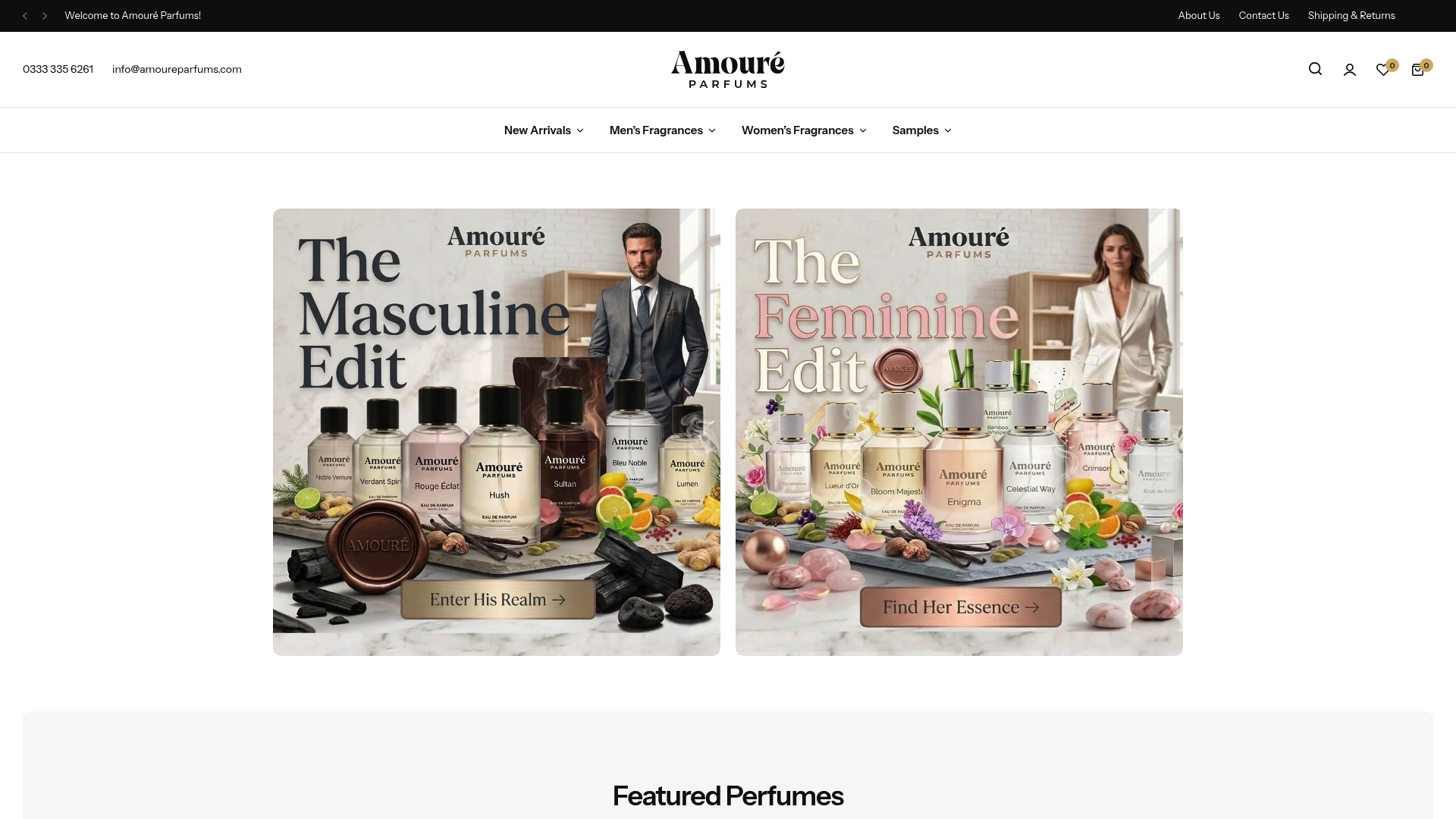
Browse our women's collection or explore our men's scents to find options that align with the classifications, notes, and occasions you have identified through your comparison process. Not sure where to start? Our sample options let you test before you commit, making hands-on comparison easy and affordable. Every scent in our range is chosen to offer genuine sophistication at a price that respects your intelligence as a shopper.
Frequently asked questions
What factors matter most when comparing perfumes?
Pay attention to fragrance notes, classification, longevity, sillage, and how the perfume matches your personal style and occasion. Platforms like Parfumo offer structured comparison tools covering all these dimensions in one place.
How can I compare perfumes if I cannot smell them in person?
Use online platforms like Parfumo and Fragrantica for detailed note pyramids, user reviews, and community ratings. Community data before buying is one of the most reliable substitutes for in-person testing.
Why do perfumes smell different on different people?
Skin chemistry, diet, and even weather can alter how perfume notes develop, making each scent unique on the wearer. This is why skin testing remains essential even after thorough online research.
Is it better to compare perfumes side by side or over several days?
Test side by side for immediate contrasts, but sample over different days and occasions to understand their full nuance and performance. Both approaches together give the most complete picture.
Should I keep a fragrance journal when comparing scents?
Absolutely. A fragrance journal helps you track impressions and note preferences, and maintaining detailed records alongside platform data is one of the most effective ways to refine your taste over time.