
A single whiff of a familiar fragrance can stop you mid-stride and pull you back to a moment you had almost forgotten. Perhaps it is your grandmother's perfume, or the scent of sunscreen from a childhood holiday. What makes this experience so startling is not just the memory itself, but how complete and emotionally charged it feels. Unlike a photograph or a song, a scent seems to bypass every filter and land directly in the heart of your past. This article explains the science behind that phenomenon, compares scent memory to other senses, and gives you practical ways to use fragrance intentionally in your own life.
Table of Contents
- Why perfumes trigger emotional memories
- Comparing scent memories to other sensory memories
- The role of familiarity and environment in scent-triggered memories
- Practical ways to harness perfume for memory and mood
- Discover unforgettable fragrances to create your own memories
- Frequently asked questions
Key Takeaways
| Point | Details |
|---|---|
| Direct brain connection | Perfumes trigger memory and emotion by bypassing standard sensory pathways and linking straight to the limbic system. |
| Emotional and vivid recall | Scents evoke richer, more emotional and involuntary memories than most other senses. |
| Familiarity matters | Personal or cultural familiarity with a scent makes it a stronger cue for memory and mood. |
| Practical scent use | You can intentionally use fragrances to enhance mood, create lasting memories, and support wellbeing. |
Why perfumes trigger emotional memories
The reason perfume is such a powerful memory trigger comes down to biology. Every other sense, sight, sound, touch, and taste, sends signals through the thalamus before they reach the emotional and memory centres of the brain. Smell is the exception. The olfactory system creates a direct neural pathway to the limbic system, connecting scents to memories and emotions without that detour. This means a fragrance reaches your amygdala (the brain's emotional processor) and hippocampus (the memory archive) almost instantly.
This shortcut is why scent memories feel so raw and immediate. There is no cognitive buffer between the smell and the feeling it produces. Researchers call this the Proust phenomenon, named after the French novelist Marcel Proust, who famously described being flooded with childhood memories after tasting a madeleine dipped in tea. The scent of the tea was the real trigger.
"Smell evokes more vivid, emotional, and involuntary autobiographical memories compared to other senses."
Think about what this means in practice. The perfume your mother wore when she dropped you off at school, the aftershave your first partner used, the floral notes of a hotel lobby from a memorable trip. These are not random associations. They are the result of your brain forming deep, emotionally tagged connections between a scent and a moment in time. Understanding how scents and personal memories intertwine helps explain why two people can smell the same perfume and have completely different emotional responses.
Here is a quick summary of what makes the olfactory pathway so distinctive:
- Scent signals travel directly to the amygdala and hippocampus
- No thalamic relay means faster, less filtered emotional responses
- Memories formed with scent cues tend to be more emotionally intense
- Involuntary recall is more common with smell than with any other sense
- The effect is strongest for memories formed during emotionally significant moments
Comparing scent memories to other sensory memories
Not all sensory memories are created equal. Each sense has its own strengths and weaknesses when it comes to triggering recall, and understanding these differences helps you appreciate exactly what perfume brings to the table.
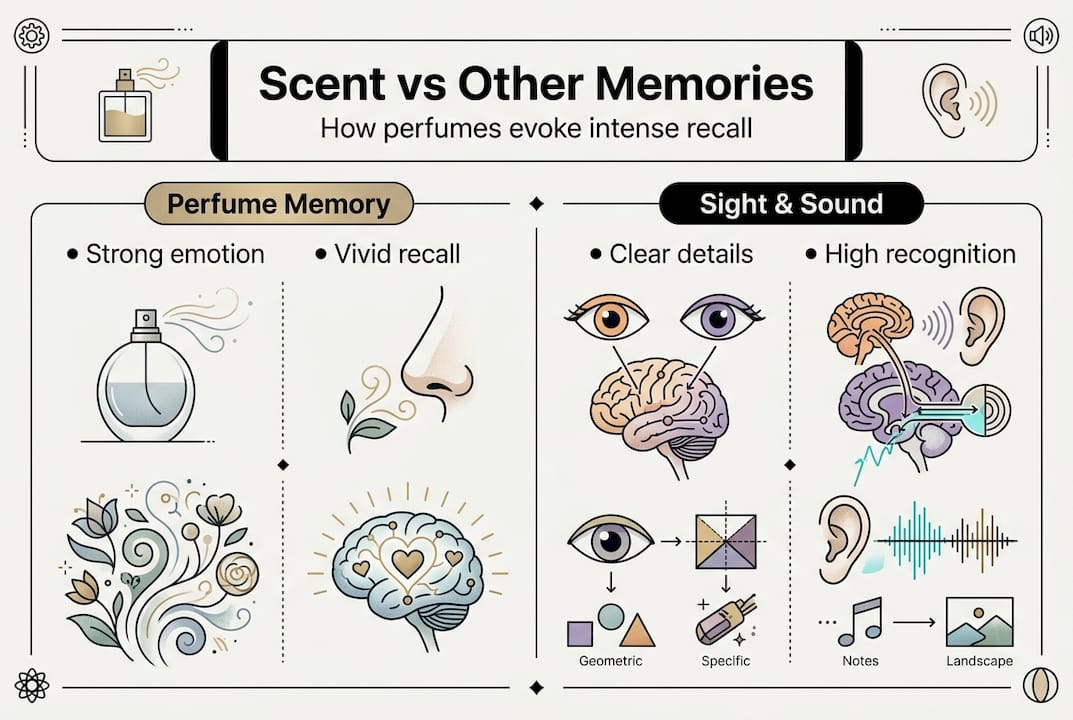
Empirical studies show scents trigger clearer, more emotional memories than pictures, with the effect being particularly strong in older adults. However, smell is not universally superior. Odours are less effective for recognition memory than visuals, music, or faces, even though they remain powerful for episodic retrieval (recalling specific life events). A meta-analysis found olfactory memory is weaker in recognition and spatial tasks compared to visual memory.
| Memory type | Emotional intensity | Recognition accuracy | Episodic recall | Spatial memory |
|---|---|---|---|---|
| Scent | Very high | Low | Very high | Low |
| Visual | Moderate | Very high | Moderate | Very high |
| Music | High | High | High | Low |
| Touch | Moderate | Moderate | Moderate | Moderate |
This table shows that perfume is not a replacement for other sensory cues. It is a specialist. It excels at pulling up emotionally rich, autobiographical memories, the kind that feel personal and lived-in. Music might help you remember the name of a song or the layout of a room, but a fragrance is more likely to make you feel the emotion of a moment.
One fascinating edge case is scent therapy for dementia. Because olfactory memory pathways are often preserved longer than other cognitive functions, familiar smells can reach patients who no longer respond to photographs or voices. The effect is also notably stronger in older people, which suggests that scent memories deepen and consolidate over time.
Pro Tip: If you want a fragrance to become a strong memory anchor, wear it consistently during emotionally significant events rather than rotating it daily. The seasonal scent influences on your mood can also shape which memories a fragrance eventually carries. Understanding fragrance notes and memory associations can help you choose scents that are more likely to form lasting impressions.
Key takeaway: Scent memory is emotionally unmatched but cognitively narrow. Use it for what it does best: anchoring feelings and personal experiences.
The role of familiarity and environment in scent-triggered memories
Not every perfume will trigger a powerful memory. The ones that do tend to share two qualities: familiarity and emotional context. Familiarity enhances cue effectiveness and is actively used in dementia therapy to evoke memories in patients who have lost access to other forms of recall.
Your personal and cultural background plays a significant role here. A scent that carries deep meaning for someone raised in a coastal town may mean nothing to someone who grew up in a city. Smell aided survival throughout human evolution, and modern perfumes leverage emotional conditioning built up over a lifetime of associations. This is why a perfume that smells generic in a shop can become profoundly personal after you wear it through a meaningful period of your life.
Environment matters too. The same fragrance can trigger different memories depending on where and when you encounter it. Smelling a woody perfume indoors in winter may evoke a completely different feeling than encountering it on a warm summer evening. Seasonal context, the setting of a room, and even your emotional state at the time of first exposure all shape what a scent comes to mean.
Here is how different factors influence the strength of a scent memory:
| Factor | Effect on memory strength |
|---|---|
| Familiarity with the scent | Strong positive effect |
| Emotional intensity at first exposure | Very strong positive effect |
| Cultural or personal relevance | Moderate to strong effect |
| Frequency of repeated exposure | Moderate effect |
| Environmental context at recall | Moderate effect |
Practical implications for your fragrance choices:
- Choose scents that already carry positive personal associations
- Wear a new fragrance during events you want to remember
- Revisit a scent from your past to reconnect with that period of your life
- Consider perfume gifting and memory as a way to create shared emotional anchors with people you care about
Pro Tip: When selecting a new signature scent, think about the memories and moods you want it to carry. A fragrance chosen with intention becomes a much richer experience over time than one picked purely for its smell in the moment.
Practical ways to harness perfume for memory and mood
Now that you understand why and how scent memory works, you can start using it deliberately. This is where fragrance moves from something passive you wear to something active you use.
In clinical settings, scents trigger more positive, detailed memories in individuals with dementia and Alzheimer's, making olfactory cues a practical tool in reminiscence therapy. You do not need a clinical context to benefit from the same principle. The same mechanism that helps a dementia patient reconnect with their past can help you anchor a holiday, a relationship, or a personal milestone to a specific fragrance.
Here are five practical steps to use perfume intentionally:
- Choose a dedicated scent for significant events. Wear a specific perfume only during a holiday, a new relationship, or a major life transition. When you smell it again later, the memory will surface with remarkable clarity.
- Start a scent journal. Note which fragrances you wear and what you were doing, feeling, or experiencing at the time. Over months, patterns emerge that reveal your personal scent-memory map.
- Use fragrance as a mood anchor. If a particular scent reliably lifts your mood or calms you, wear it intentionally before situations where you need that emotional state.
- Rotate seasonally with purpose. Assign different fragrances to different seasons or chapters of your year. This creates a natural archive of scent memories that you can revisit. Exploring the role of a perfumer in crafting signature scents can deepen your appreciation for how intentional fragrance creation really is.
- Layer fragrances thoughtfully. Combining a base scent with a complementary top note creates a unique signature that is harder to replicate and therefore more distinctly yours.
Additional habits worth building:
- Smell a fragrance before buying it, then wear it for a full day before deciding
- Revisit old perfumes periodically to reconnect with the memories they carry
- Give fragrances as gifts tied to shared experiences, not just as generic presents
- Avoid wearing your memory-anchor scent too casually, or it loses its associative power
Pro Tip: Keep one fragrance exclusively for your most important annual rituals, whether that is a birthday, a holiday tradition, or a personal celebration. The repetition builds a scent memory so strong that a single spray can transport you back through years of that same occasion.
Discover unforgettable fragrances to create your own memories
Every memory worth keeping deserves a scent to go with it. At Amoureé Parfums, we believe that the right fragrance is not just something you wear; it is something you live in and return to. Our curated collection is designed to help you find scents that resonate personally, whether you are looking for something warm and grounding or light and uplifting.
Explore our full range of fragrances to find a scent that speaks to your story. Whether you prefer something floral and feminine from our women's fragrances collection or something bold and distinctive from our men's fragrances range, each bottle is an invitation to create a memory worth revisiting. With detailed scent notes and expert guidance, finding your next signature scent has never felt more personal.
Frequently asked questions
Why do certain perfumes remind me so strongly of specific people or places?
Perfumes connect directly to the brain regions responsible for emotion and memory, bypassing the usual cognitive filters. This direct neural pathway to the limbic system is why the recall feels so immediate and emotionally charged.
Can fragrance really help people with dementia or Alzheimer's recall memories?
Yes. Scent therapy triggers positive, detailed memories in individuals with dementia, helping them reconnect with personal experiences even when other cognitive functions have declined.
Does everyone experience perfume-triggered memories the same way?
No. The strength and nature of scent memories depend on personal history, cultural background, and how familiar you are with the perfume. Familiarity and background shape how effectively a scent cue works for any individual.
Are scent memories always stronger than memories triggered by sights or sounds?
Not always. Scent memories tend to be more emotional and vivid, but olfactory memory is less effective for recognition and spatial tasks compared to visual memory. Each sense has its own strengths.