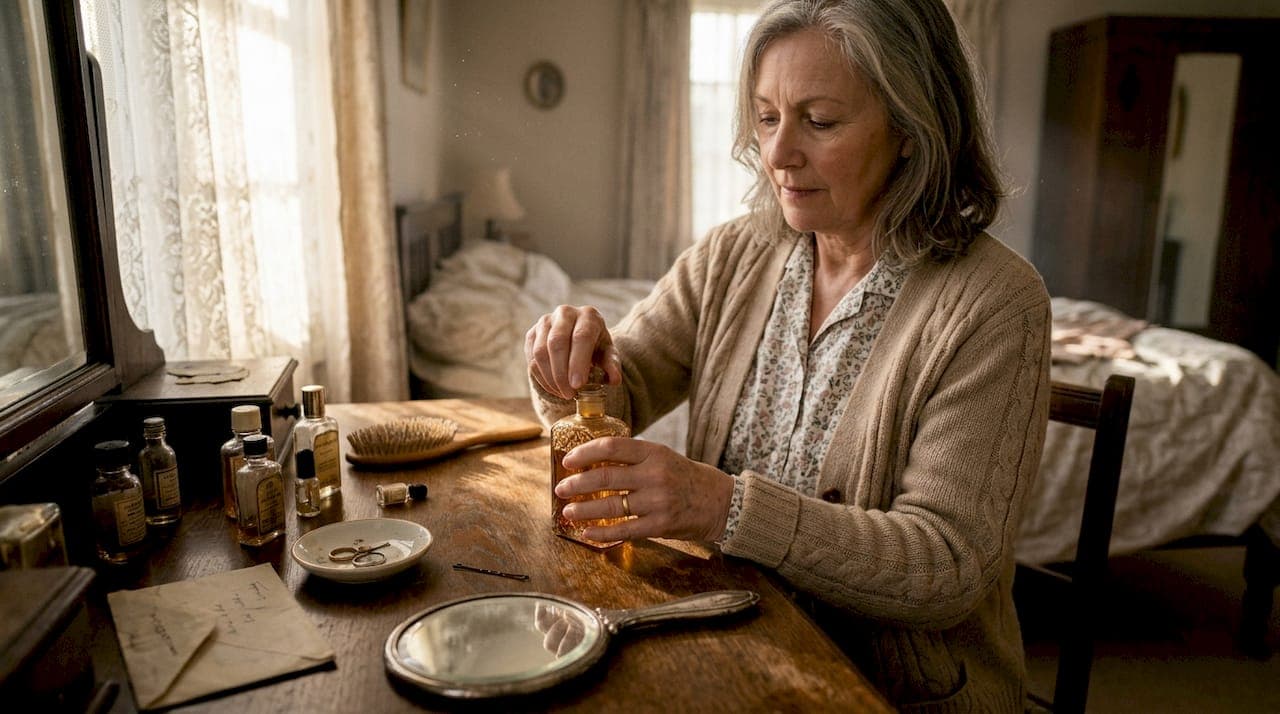
Pick up any bottle in a department store and the message is immediate: this one is for her, that one is for him. Yet studies reveal that many men's and women's fragrances share remarkably similar chemical compositions, differing mainly in their packaging and labelling. Gendered scent associations link florals and powdery notes to women and woody, spicy notes to men, reinforced far more by advertising than by any natural law. Understanding why perfumes are gendered, and what that means for your own choices, is the first step towards finding a scent that truly suits you.
Table of Contents
- How gendered perfumes emerged: a brief history
- The scent notes: what defines 'masculine' and 'feminine'?
- Cultural influence: how society shapes our scent choices
- Unisex, niche and the future of fragrance
- Finding your signature: why personal choice matters
- Explore gendered and unisex fragrances with Amoureé Parfums
- Frequently asked questions
Key Takeaways
| Point | Details |
|---|---|
| Gendered scents are cultural | Perfume labels as masculine or feminine are shaped by marketing and societal convention rather than inherent scent qualities. |
| Consumer preference is learned | Most people gravitate toward scents labelled for their gender due to habit and advertising. |
| Unisex market is rising | Unisex perfumes now make up nearly 40% of premium sales, reflecting changing attitudes and self-expression. |
| Personal choice is key | There are no fixed rules—find a fragrance that feels true to you, regardless of gender label. |
How gendered perfumes emerged: a brief history
To understand why perfumes are gendered, we need to explore where these distinctions began. For most of human history, fragrance was entirely unisex. Ancient Egyptians, Greeks, and Romans applied the same aromatic resins and floral waters regardless of sex. Perfume was about status, ritual, and pleasure, not gender.
The shift came gradually with industrialisation and the rise of modern marketing. Victorian society began associating delicate florals with femininity and assertive, resinous scents with masculinity. By the mid-20th century, post-war consumer culture had fully codified these categories. Brands launched distinct product lines for men and women, and advertising cemented the idea that crossing those lines was somehow inappropriate.
One of the most telling examples is the history of gendered scents surrounding the Fougère family. Fougère fragrances originally targeted women in 1882 but became one of the defining masculine archetypes of the 20th century. That reversal alone shows how arbitrary these associations truly are.
Key moments in the gendering of fragrance:
- Ancient era: Fragrance used universally across genders for ritual and status
- Victorian period: Florals coded as feminine; heavy resins and tobacco as masculine
- 1920s to 1950s: Luxury houses launch separate men's and women's lines
- Post-war boom: Mass-market advertising locks in gendered scent identities
- Late 20th century: Niche houses begin questioning these conventions
"The gendering of fragrance is not a natural phenomenon. It is a commercial and cultural construction that has evolved, reversed, and reinvented itself across centuries."
Understanding how scent perception secrets interact with memory and expectation helps explain why these historical associations feel so instinctive today, even when they are entirely learned.
The scent notes: what defines 'masculine' and 'feminine'?
With the historical context in mind, let us examine the notes that define these gender categories. The fragrance industry organises scents into families: floral, oriental, woody, fresh, citrus, and fougère, among others. Each family carries cultural baggage about who should wear it.
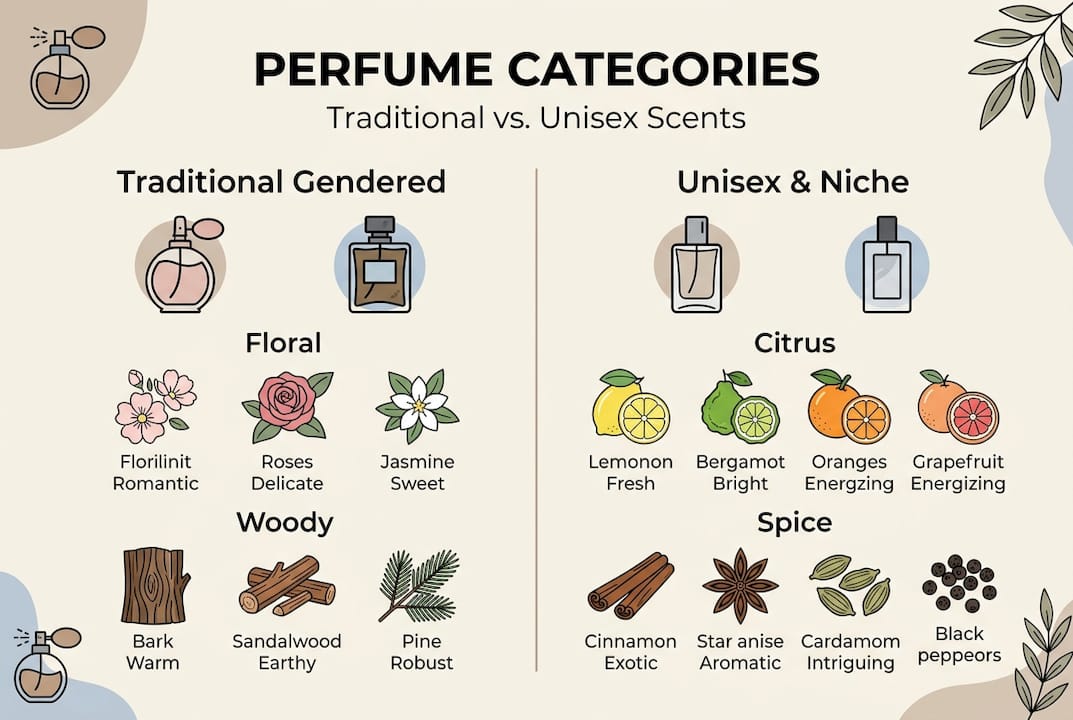
Gendered scent conventions assign florals, powdery accords, and fruity notes to women's fragrances, while woody, spicy, citrus, and leather notes are marketed predominantly to men. These are conventions, not rules. A rose note smells like a rose regardless of who wears it.
| Scent family | Typically marketed to women | Typically marketed to men |
|---|---|---|
| Floral | Rose, jasmine, peony | Rarely used as lead note |
| Woody | Sandalwood (soft) | Cedarwood, vetiver, oud |
| Oriental | Vanilla, amber, musk | Tobacco, incense, dark amber |
| Citrus | Bergamot, neroli | Bergamot, grapefruit, lime |
| Fougère | Rarely | Lavender, oakmoss, coumarin |
| Fruity | Peach, raspberry, pear | Rarely used as lead note |
Advertising language does enormous work here. Words like powerful, bold, and intense appear on men's bottles. Words like delicate, romantic, and sensual appear on women's. The vocabulary shapes expectation before you even smell the juice.
Here are the notes most commonly associated with each marketed gender:
- Women's fragrances: Rose, jasmine, iris, peony, vanilla, peach, musk, powdery accords
- Men's fragrances: Cedarwood, vetiver, leather, tobacco, bergamot, black pepper, oakmoss
- Shared territory: Sandalwood, patchouli, amber, neroli, and many citrus notes appear in both
Explore classic men's fragrance notes and feminine perfume styles to see how these conventions play out in real collections. For a deeper breakdown of how notes layer together, fragrance notes explained is an excellent starting point.
Pro Tip: Next time you sample a fragrance, cover the bottle and ignore the name. Let your nose decide before your eyes do. You may be surprised which notes genuinely appeal to you.
Cultural influence: how society shapes our scent choices
Now that you know what goes into 'masculine' and 'feminine' scents, it is time to look at how cultural forces influence those choices. Socialisation begins early. Children observe which fragrances adults around them wear, absorb advertising imagery, and internalise the idea that certain scents belong to certain people.

Media and advertising reinforce this constantly. A men's fragrance campaign typically features rugged landscapes, physical confidence, and independence. A women's campaign leans into romance, softness, or glamour. These images are not describing the scent; they are constructing an identity around it.
The result is measurable. Consumer preferences shift when scents are labelled for their gender, with people rating the same fragrance more favourably when it matches their own gender label, even when the formula is nearly identical. The label does as much work as the liquid inside.
"Gender labelling in fragrance is not just a marketing shortcut. It actively shapes what consumers believe they smell and whether they enjoy it."
How cultural conditioning shapes scent preference:
- Early exposure: Children observe gendered fragrance use at home and in media
- Advertising imagery: Campaigns attach identity narratives to specific scent profiles
- Retail environment: Separate counters and packaging reinforce the division physically
- Social reinforcement: Compliments and reactions from others validate gendered choices
- Label bias: The same scent rated differently depending on its marketed gender
Context matters too. Seasonal fragrances and cultural context shows how occasion, climate, and setting all influence which scents feel appropriate, adding another layer of social expectation on top of gender conventions.
Unisex, niche and the future of fragrance
Having seen how gendered fragrance preferences are shaped, let us examine what happens when those boundaries blur. Unisex fragrances are designed to be worn by anyone, typically built around notes that sit in the shared territory between traditional gender categories: woods, musks, ambers, and clean citrus accords.
Niche perfumery, which prioritises artistic expression over mass-market appeal, has long resisted gender labelling. Houses like Maison Margiela, Le Labo, and Byredo rarely market by gender at all. Their approach has influenced the broader industry significantly.
The numbers reflect a genuine shift. The unisex fragrance market was valued at €19.75 billion in 2023 and is projected to reach €33.42 billion by 2031, growing at a 6.81% CAGR. It already represents nearly 40% of premium fragrance sales, driven largely by Gen Z and Millennials who prioritise self-expression over inherited norms.
| Feature | Traditional gendered fragrances | Unisex and niche fragrances |
|---|---|---|
| Marketing approach | Gender-specific imagery and language | Identity and mood focused |
| Scent profile | Defined by gender conventions | Broader, more experimental |
| Price point | Wide range, mass to luxury | Often premium or niche |
| Target audience | Gender-segmented | All genders, self-expressive buyers |
| Market trajectory | Stable but slower growth | Rapid expansion |
However, traditional gendered perfumes are far from disappearing. The women's fragrance market alone was valued at USD 43.39 billion in 2023 and is projected to reach USD 69.20 billion by 2031. Consumer conditioning runs deep, and many buyers actively want a scent that feels aligned with their gender identity. Both markets are growing; they are simply growing for different reasons.
Pro Tip: If you are curious about unisex options but unsure where to start, look for fragrances built around sandalwood, vetiver, or clean musk. These notes sit comfortably across gender lines and tend to wear beautifully on all skin types. Browse the full fragrance range to explore options across all categories.
Finding your signature: why personal choice matters
Now that the landscape is changing, here is how to embrace fragrance as a personal style statement. The most important thing to understand is that label-driven preferences are real but not fixed. Awareness of how they work gives you the freedom to move past them.
Your taste in fragrance will also evolve. The scents you loved at twenty may feel entirely wrong at thirty-five. That is not inconsistency; it is growth. Skin chemistry changes, life experiences shift your associations, and your sense of identity deepens over time.
Practical ways to find your signature scent without bias:
- Sample blind: Try fragrances without reading the name or gender label first
- Test on skin: Paper strips give a misleading impression; always test on your wrist
- Give it time: A fragrance needs at least thirty minutes to reveal its true character on your skin
- Ignore the bottle: Packaging is designed to sell a lifestyle, not describe a scent
- Trust your reaction: If a note makes you feel confident or comfortable, that is your answer
- Revisit old choices: A scent you dismissed years ago may now feel exactly right
Fragrance is one of the most intimate forms of self-expression available. Whether you love a classic floral, a dark woody oriental, or a clean unisex musk, the right scent is simply the one that feels like you. For those looking to share that experience, sophisticated gifting options can help you find something meaningful for someone else too.
Explore gendered and unisex fragrances with Amoureé Parfums
Whether you are drawn to classic gendered profiles or curious about boundary-crossing unisex options, Amoureé Parfums has a curated collection to match every preference and personality. Each fragrance in the range is selected for quality, longevity, and character, so you can shop with confidence rather than guesswork.
Browse the men's fragrances collection for bold, sophisticated profiles built around woods, spice, and citrus. Discover the women's fragrances collection for elegant florals, warm orientals, and everything in between. Or explore the full fragrance range if you prefer to let your nose lead the way, free from labels and expectations. With detailed scent notes, expert picks, and 24/7 customer support, finding your next signature scent has never been more straightforward.
Frequently asked questions
Are perfumes naturally gendered or is it all marketing?
Perfumes are not inherently gendered. These associations are culturally constructed, built through advertising language, packaging, and social convention rather than any quality intrinsic to the scent itself.
Why do most people still buy gendered perfumes?
Label-driven preferences are powerful: people consistently rate the same fragrance more favourably when it is labelled for their gender, making habit, social cues, and targeted marketing the primary drivers of gendered purchasing behaviour.
What is a unisex scent and is it becoming more popular?
A unisex fragrance is designed to be worn by anyone, regardless of gender. The unisex market reached €19.75 billion in 2023 and already accounts for nearly 40% of premium sales, with strong growth projected through 2031.
Can I wear a 'men's' fragrance if I'm a woman, or vice versa?
Absolutely. Scent is entirely personal, and there are no rules about who can wear what. The only question worth asking is whether the fragrance makes you feel the way you want to feel.
Why do gendered fragrances persist despite the rise in unisex options?
Consumer conditioning is deeply ingrained, and many buyers actively seek scents that align with their gender identity. The women's fragrance market alone is projected to reach USD 69.20 billion by 2031, demonstrating that traditional gendered categories remain commercially robust alongside the unisex boom.