TL;DR:
- Fragrance concentration indicates the ratio of aromatic compounds, affecting scent longevity and depth.
- Higher concentrations like parfum last longer and emphasize base notes, but labels are not standardized.
- Personal factors and skin chemistry influence how long a fragrance lasts, regardless of concentration.
You pick up two bottles from the same brand. Same name on the label, same general scent family, yet one lasts all day and the other fades by noon. The difference almost certainly comes down to fragrance concentration, the ratio of aromatic compounds to alcohol and water in the formula. This single factor shapes how a perfume smells on your skin, how long it lingers, and why one bottle costs twice as much as another. Understanding it properly means you stop guessing at the counter and start choosing with confidence.
Table of Contents
- What does fragrance concentration mean?
- Comparing fragrance concentration: Parfum, eau de parfum, eau de toilette, and cologne
- How fragrance concentration affects scent profile and longevity
- Choosing the right fragrance concentration for your needs
- Why the industry's concentration conventions can be misleading
- Discover premium fragrance options at Amoureé Parfums
- Frequently asked questions
Key Takeaways
| Point | Details |
|---|---|
| Concentration drives longevity | The percentage of aromatic ingredients in fragrance affects how long it lasts on skin. |
| Category conventions vary | Industry definitions for parfum, eau de parfum, and eau de toilette are not legally regulated. |
| Scent profile changes | Higher concentrations often enhance deeper notes and alter the way a fragrance develops. |
| Smart selection matters | Choosing the right concentration depends on your skin, lifestyle, and scent goals. |
| Sampling is key | Trying samples helps you experience how concentration affects the scent before buying full-size bottles. |
What does fragrance concentration mean?
Fragrance concentration refers to the percentage of aromatic compounds, often called the 'fragrance oil' or 'perfume oil', present in a formula relative to its carrier, which is typically alcohol and sometimes a small amount of water. The higher this percentage, the more aromatic material sits on your skin with each spray.
Think of it like brewing tea. A weak brew uses little tea and lots of water. A strong brew reverses that ratio. The fundamental character is the same, but the depth, colour, and staying power are entirely different. Fragrance concentration works in precisely the same way.
The industry uses several recognised categories to communicate concentration levels:
- Parfum (extrait de parfum): Typically 20% to 40% aromatic compounds. The richest, most intense option.
- Eau de parfum (EDP): Usually 15% to 20%. Strong, long-lasting, and the most popular premium category.
- Eau de toilette (EDT): Generally 8% to 15%. Lighter and fresher, ideal for daytime wear.
- Eau de cologne (EDC): Around 2% to 4%. The lightest category, often used for casual or sport contexts.
- Eau fraîche: Typically 1% to 3%. Very light, often water-based rather than alcohol-based.
Here is where things get interesting. Concentrations are industry conventions without strict legal regulation, meaning one brand's EDP could technically contain a higher concentration than another brand's parfum. The labels guide expectations but do not guarantee identical formulations across houses.
Higher concentration does not simply mean a louder, more aggressive scent. It often means greater depth, a slower reveal of the fragrance's structure, and a stronger emphasis on the deeper, longer-lasting fragrance notes explained that form the dry-down.
Pro Tip: If you love the base notes of a fragrance, such as sandalwood, amber, or musk, a higher concentration version will bring those qualities to the foreground more prominently and keep them on your skin far longer.
Comparing fragrance concentration: Parfum, eau de parfum, eau de toilette, and cologne
Now that the foundations are clear, here is a direct comparison of the main categories to help you see the practical differences at a glance.
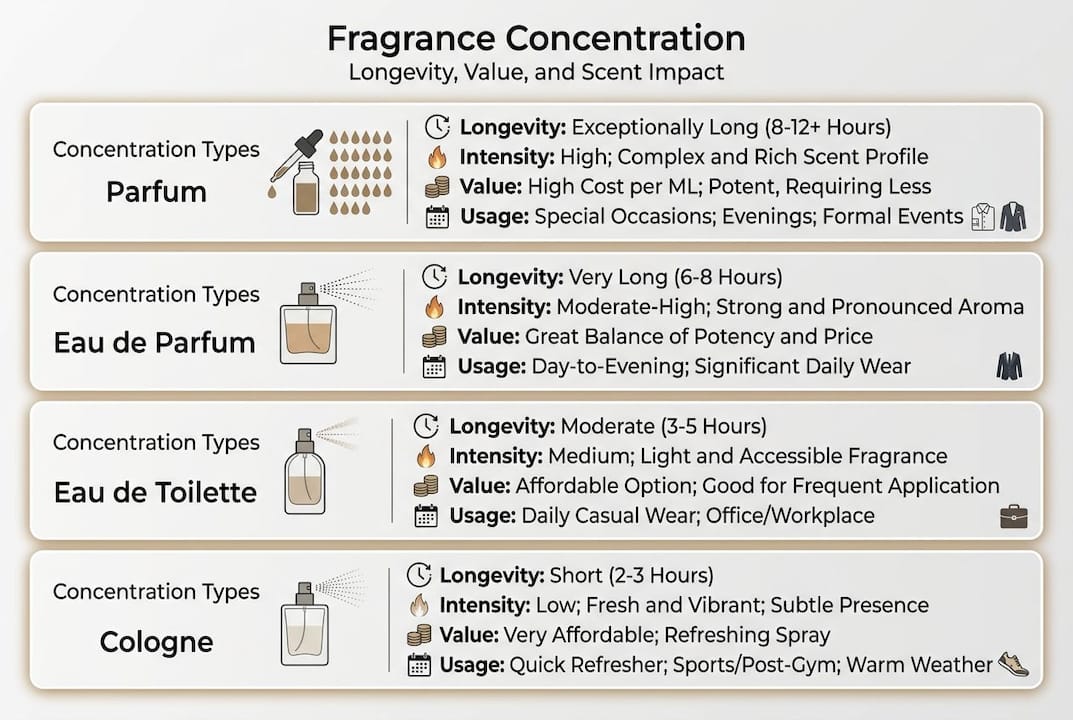
| Type | Concentration | Longevity | Intensity | Price bracket |
|---|---|---|---|---|
| Parfum | 20–40% | 8–12+ hours | Very high | Premium |
| Eau de parfum | 15–20% | 6–8 hours | High | Mid to high |
| Eau de toilette | 8–15% | 3–5 hours | Moderate | Mid-range |
| Eau de cologne | 2–4% | 2–3 hours | Light | Accessible |
| Eau fraîche | 1–3% | 1–2 hours | Very light | Budget |
As concentrations vary, they enhance different notes and affect scent longevity in ways that go beyond simply 'stronger or weaker'. A well-crafted eau de parfum explained can feel more nuanced and wearable than a parfum from a lesser house.
Choosing the right category depends on what you actually want from a fragrance. Here is a practical guide:
- For all-day presence without reapplication: Opt for parfum or EDP. These concentrations are designed to evolve over hours and reward patience.
- For office or daytime wear: EDT strikes the right balance. It projects enough to be noticed without overwhelming a shared space.
- For sport, warm weather, or casual use: EDC or eau fraîche offers a refreshing lift that suits high-activity situations where a heavier scent would feel cloying.
- For exploring a new fragrance: Start with an EDT or EDP. They give you a genuine sense of a scent's character without the full financial commitment of a parfum bottle.
It is also worth noting that perfume scent secrets play a role here. Your skin chemistry interacts with concentration levels differently, meaning the same EDP can smell richer on one person and sharper on another.
How fragrance concentration affects scent profile and longevity
Understanding the categories is one thing. Seeing how concentration actually changes your experience on skin is another.
When the same fragrance is produced at different concentrations, it does not simply become louder or quieter. As higher concentrations favour base notes, the EDT version of a scent might lead with bright citrus top notes that fade quickly, while the parfum version of the same fragrance opens more quietly but reveals a rich, woody heart that lasts all evening. They can feel like entirely different perfumes.
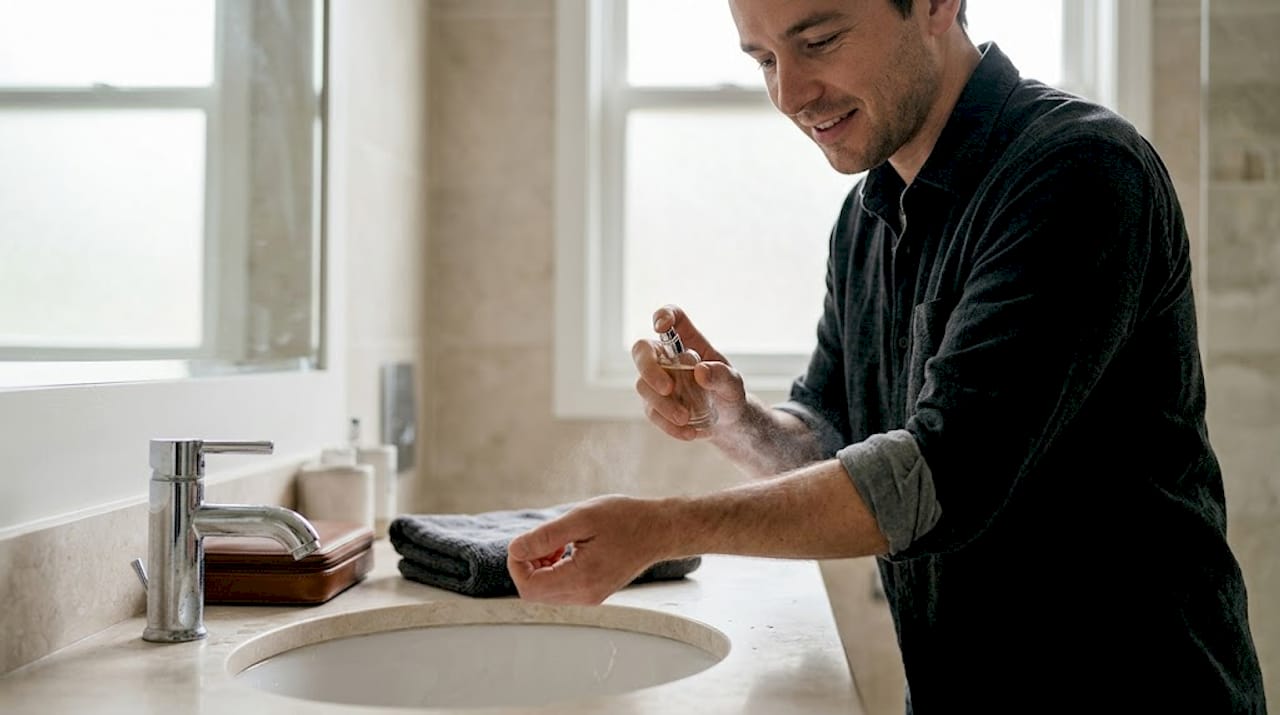
Here is how longevity typically maps across concentration types:
| Concentration | Average longevity | Projection distance |
|---|---|---|
| Parfum | 8–12+ hours | Close to skin |
| Eau de parfum | 6–8 hours | Moderate |
| Eau de toilette | 3–5 hours | Noticeable |
| Eau de cologne | 2–3 hours | Light, immediate |
Several factors beyond concentration affect how long a scent lasts on you. Understanding these helps you get the most from any bottle:
- Skin chemistry: Oilier skin holds fragrance longer than dry skin, regardless of concentration.
- Hydration: Moisturised skin retains scent molecules more effectively. Applying an unscented lotion before your fragrance extends wear noticeably.
- Application point: Pulse points such as wrists, neck, and inner elbows generate warmth that activates and projects scent notes more effectively.
- Environment: Heat and humidity amplify projection. Cold, dry air suppresses it.
- Clothing: Fabric holds fragrance far longer than skin, which is why scent differs so much between wearers.
Pro Tip: Layering an EDT over a matching body lotion or a parfum version of the same scent creates a multi-dimensional effect that outlasts either product worn alone. This is a technique used by fragrance professionals to build a truly personal scent signature.
Choosing the right fragrance concentration for your needs
With an understanding of scent behaviour, here is how to make fragrance concentration work for you practically.
The honest truth is that personal factors are key to choosing appropriately, and industry conventions only take you so far. A parfum is not automatically the right choice just because it carries the highest concentration.
Consider these factors before you buy:
- Occasion: A heavy parfum in a warm office can become overwhelming. An EDT offers better social consideration in close quarters.
- Season: Lighter concentrations suit summer heat, where fragrance projects naturally. Heavier concentrations work well in winter, when cold air suppresses projection.
- Skin type: If your skin runs dry, a higher concentration compensates for faster evaporation. Oilier skin types often get excellent longevity from an EDP without needing to step up to parfum.
- Budget: A well-formulated EDT from a quality house often outperforms a poorly crafted parfum. Price and concentration together are not a reliable quality indicator.
- Frequency of use: For everyday wear, an EDT or EDP offers better value and flexibility. Reserve parfum for occasions where you want a scent to truly last.
The most important piece of fragrance shopping tips any expert will give you is to sample before you commit. Sampling fragrances across concentrations of the same scent reveals nuances that no description can capture. When you build a perfume collection, having different concentrations of a favourite fragrance gives you genuine versatility across seasons and occasions.
Pro Tip: Try wearing an EDT in the morning and layering a small amount of the parfum version at your pulse points in the evening. The result is a richer, longer-lasting version of your favourite scent without committing to the full parfum price point all day.
Why the industry's concentration conventions can be misleading
Here is something the fragrance industry does not advertise loudly: the labels on your bottles are not governed by any universal legal standard. Concentration labels can vary between brands, meaning an EDP from one house might genuinely outperform a parfum from another in both longevity and depth.
We have seen customers spend considerably more on a parfum, expecting transformative longevity, only to find a well-crafted EDP from a quality house delivered a richer experience. The truth is that craftsmanship, ingredient quality, and formula construction matter far more than the concentration percentage printed on the box.
This is why identifying premium fragrances requires looking beyond the label. The role of fragrance houses in luxury perfumery is precisely this: to construct formulas where every percentage point of aromatic material is purposeful, not just present. Use concentration as a useful starting point, not a definitive measure of quality or value. Your nose, ultimately, is the most reliable guide you have.
Discover premium fragrance options at Amoureé Parfums
Exploring concentration types is far more rewarding when you have access to genuinely well-crafted options across the full range.
At Amoureé Parfums, we curate a selection of premium fragrances designed to give you real choice across concentrations and scent profiles. Whether you are drawn to the lasting depth of an EDP or the freshness of a lighter formula, our collection is built for enthusiasts who take their fragrance seriously. Browse our women's fragrances or explore the full shop fragrances range to find your next signature scent. Better still, try fragrance samples before committing to a full bottle, so concentration is never a guessing game again.
Frequently asked questions
What is fragrance concentration?
Fragrance concentration is the ratio of aromatic compounds to alcohol and water in a perfume or cologne, determining its strength, character, and how long it lasts on skin.
Which fragrance concentration lasts the longest?
Parfum lasts longest due to its high aromatic content, typically remaining perceptible on skin for 8 to 12 hours or more, depending on skin type and environment.
Does higher fragrance concentration always mean a stronger scent?
Not always. Higher concentration favours base notes and longevity rather than immediate intensity, so a parfum may actually open more quietly than an EDT before deepening over time.
Is fragrance concentration regulated by law?
No. Concentration categories are not regulated by any universal legal standard, so the same label can represent different actual percentages depending on the brand or house.
How can I sample different fragrance concentrations?
Many quality fragrance retailers offer sample sets or discovery kits, which allow you to wear and compare concentrations on your own skin before investing in a full bottle.