
TL;DR:
- Perfume creation involves months of sourcing ingredients, blending, and maturation.
- Natural and synthetic ingredients are carefully selected to craft complex, enduring fragrances.
- Luxury perfumes distinctively invest time and quality control, resulting in deeper, more nuanced scents.
Most people assume that perfume is simply a pleasant liquid poured into a beautiful bottle. In reality, every fragrance you spray on your wrist is the result of months of creative decision-making, global ingredient sourcing, and painstaking refinement. The journey from a blank creative brief to a finished scent involves chemistry, artistry, and a level of patience that most industries rarely demand. Whether you are a lifelong fragrance lover or someone just beginning to explore the world of perfume, understanding how these scents are made will permanently change the way you experience them.
Table of Contents
- From creative brief to sourcing ingredients
- Crafting the fragrance: blending top, heart and base notes
- Dilution, maturation and quality control
- Expert nuances: molecular magic, modern trends and sustainability
- The craft that sets luxury fragrances apart
- Experience the artistry of Amoureé Parfums
- Frequently asked questions
Key Takeaways
| Point | Details |
|---|---|
| Begin with creativity | Every fragrance starts as a unique idea crafted through careful planning and artistic vision. |
| Scientific blending | Skilled perfumers design complex scents by balancing top, heart, and base notes. |
| Quality through patience | Maturation and rigorous control processes are essential for producing a fine, lasting perfume. |
| Skin and sustainability matter | How a perfume develops depends on your skin, ingredient choice, and ethical production. |
| Luxury stands apart | True artisanal fragrances invest in rare materials and craft, offering depth mass-market scents can’t match. |
From creative brief to sourcing ingredients
Every perfume begins not in a laboratory, but with an idea. Before a single ingredient is measured, a concept and creative brief is developed that defines the target audience, the emotional mood, and the market positioning of the fragrance. Think of it like writing a story before you pick up a pen. A perfumer needs to know whether the scent should feel warm and intimate or fresh and energetic before selecting a single ingredient.
The perfumer's creative role at this stage is part artist, part strategist. They must translate abstract emotions and brand values into a sensory experience. Once the brief is clear, the sourcing process begins, and this is where things get genuinely fascinating.
Ingredients fall into two broad categories: naturals and synthetics. Natural materials are harvested from across the globe, including flowers, spices, woods, and resins. The way a fragrance house sources these materials has a direct impact on the final scent's quality and character. Delicate botanicals like jasmine, for instance, cannot withstand the heat of steam distillation, so solvents must be used instead, which affects both yield and cost.
Synthetic molecules, on the other hand, allow perfumers to create novel scents impossible naturally, while naturals remain prized for their unmatched depth and complexity. Neither category is superior. The real skill lies in knowing when to use each.
Here are the most commonly sourced ingredient types:
- Florals: Rose, jasmine, ylang-ylang (often solvent-extracted)
- Woods and resins: Sandalwood, oud extraction, benzoin
- Citrus: Bergamot, lemon, grapefruit (cold-pressed from rinds)
- Synthetics: Musks, aldehydes, aromachemicals for consistency and innovation
- Spices: Cardamom, pepper, clove (steam-distilled or CO2-extracted)
Pro Tip: When you smell a fragrance that has an almost impossible quality, like the scent of rain or the ocean, that is almost certainly a synthetic molecule at work. Nature cannot always bottle itself.
Crafting the fragrance: blending top, heart and base notes
Once the right materials are selected, the real creative work begins. Blending is the process of combining individual ingredients into a structured, harmonious whole. It is both deeply technical and intensely personal.
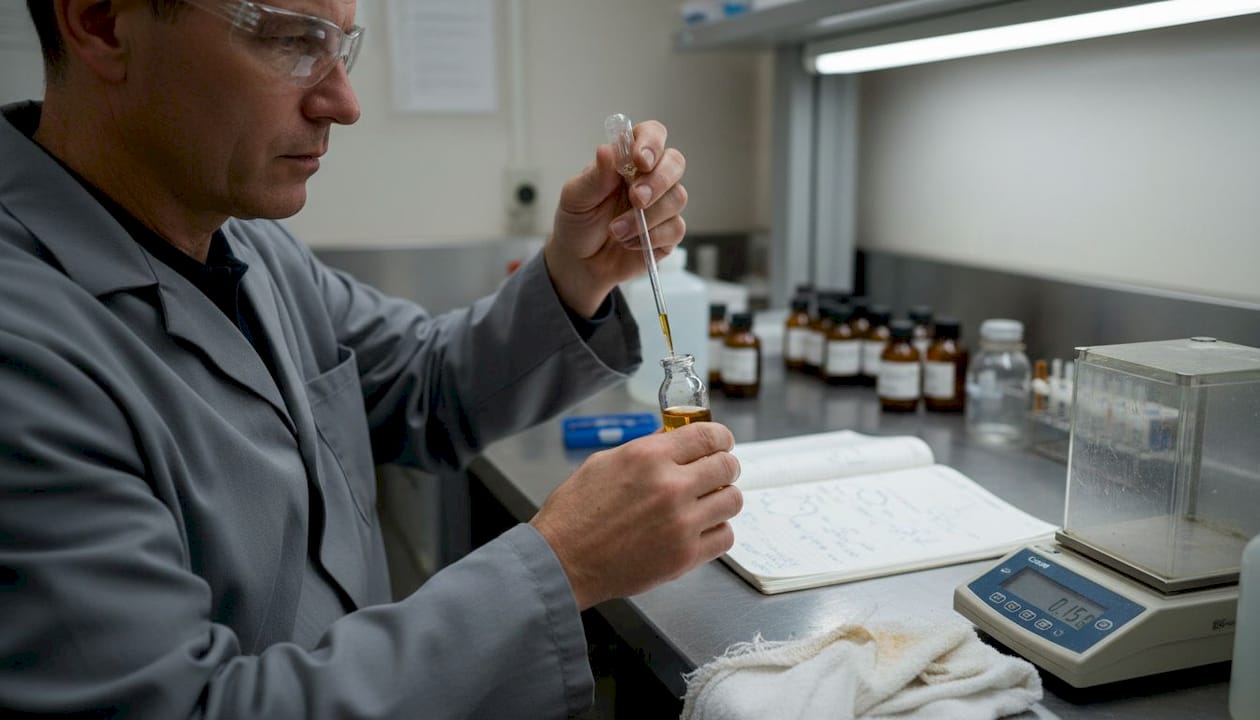
Every fragrance is built around a three-tier structure of fragrance note structures that unfold over time on your skin. Understanding these layers changes how you experience every scent you wear.
| Note type | Proportion | Lifespan on skin | Typical ingredients |
|---|---|---|---|
| Top notes | 20-40% | 5-15 minutes | Citrus, light herbs, aldehydes |
| Heart notes | ~50% | 2-4 hours | Florals, spices, green notes |
| Base notes | 20-30% | 6+ hours | Musks, woods, resins, vanilla |
As the blending process shows, top notes make up 20-40% of the concentrate and are the most volatile, evaporating within minutes. Heart notes form the emotional core at around 50%, lasting two to four hours. Base notes anchor the entire composition, lingering for six hours or more.
The emotional impact of scent is largely shaped by how these layers interact over time. A fragrance that smells bright and citrusy at first spray might reveal a rich, woody warmth an hour later. That transformation is entirely intentional.
Here is how a perfumer typically approaches the blending process:
- Start with the base: anchor the composition with long-lasting materials
- Build the heart: add the emotional centrepiece of the fragrance
- Layer the top: introduce the first impression that draws people in
- Evaluate on skin: skin changes everything, so strip testing alone is never enough
- Adjust and iterate: most formulas go through dozens of revisions before approval
Interestingly, gender and fragrance notes have historically influenced which note profiles are marketed to whom, though this is shifting rapidly as fragrance becomes increasingly gender-neutral.
Dilution, maturation and quality control
With the fragrance blend finalised, the formula enters a stage that many people never think about: transformation into the actual product you buy. This involves dilution, maturation, and rigorous quality checks.
The concentrated fragrance oil is diluted in ethanol, typically at 70-85% ethanol concentration, sometimes with a small amount of water added. The ratio of fragrance oil to ethanol determines the product category.
| Product type | Fragrance oil concentration | Typical longevity |
|---|---|---|
| Parfum (extrait) | 20-30% | 8-12 hours |
| Eau de parfum | 15-20% | 6-8 hours |
| Eau de toilette | 8-15% | 4-6 hours |
| Eau de cologne | 2-4% | 2-3 hours |
After dilution, the mixture undergoes maceration, a resting period where the oils and solvents are left to fully integrate. This process takes a minimum of 2-12 weeks, and complex luxury fragrances may rest for up to six months. Think of it like ageing wine. The extra time allows the molecules to bond, soften, and develop nuance that simply cannot be rushed.
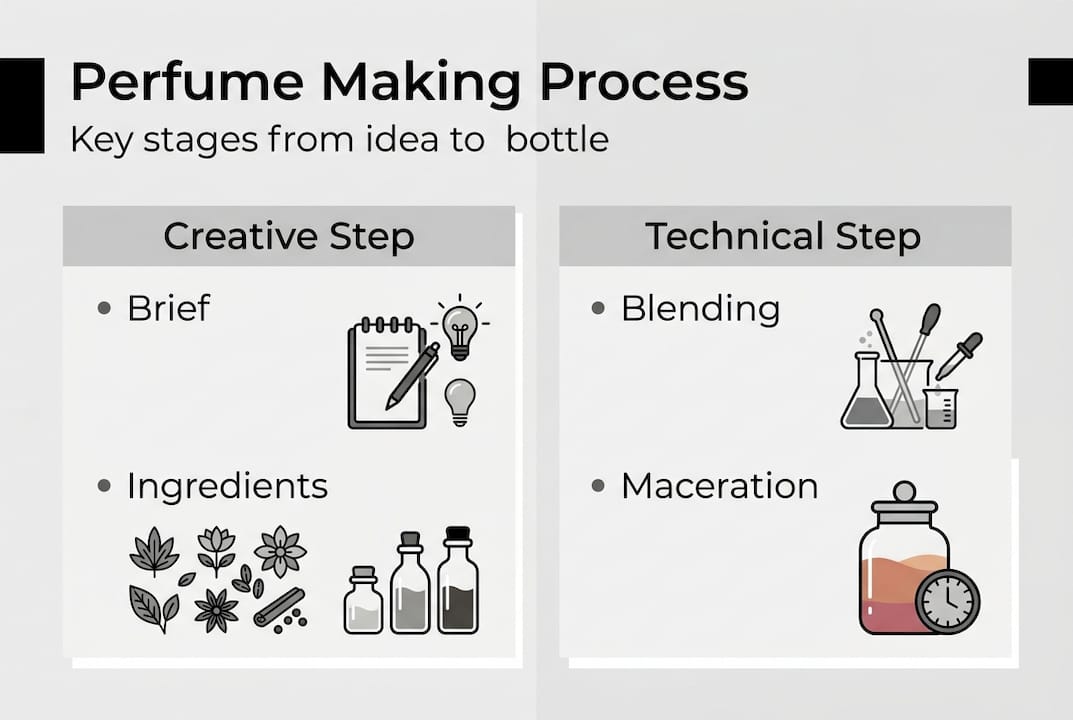
Pro Tip: If you have ever bought a fragrance and found it smelled slightly different after a few months in your collection, you have experienced maceration continuing in the bottle. Properly stored perfumes can actually improve with a little age.
After maturation, the fragrance is filtered to remove any sediment or cloudiness, then subjected to quality control checks covering colour, clarity, odour consistency, and chemical composition. Only then does it move to bottling and packaging.
Key quality control steps include:
- Odour evaluation: Trained evaluators compare each batch against a reference standard
- Chemical analysis: Gas chromatography confirms ingredient ratios are correct
- Stability testing: The fragrance is exposed to heat and light to predict shelf life
- Skin safety checks: Patch testing and allergen screening before release
For anyone wanting to identify high-quality perfume, understanding this process makes it far easier to spot the difference between a carefully crafted fragrance and a rushed one.
Expert nuances: molecular magic, modern trends and sustainability
Having followed the physical process from conception to bottling, there are deeper, sometimes invisible, factors that shape every spray of perfume.
One of the most surprising realities of perfumery is that the same fragrance can smell genuinely different on two people. This is not a myth. Evaporation varies by skin type and hydration levels, meaning a dry-skinned person may experience a fragrance as sharper and more fleeting, while someone with oilier skin holds the scent longer and warmer. Your diet, hormones, and even the climate you live in all play a role.
"The skin is not a neutral canvas. It is an active participant in the fragrance experience, altering how molecules rise, fade, and interact with the air around you."
This is why understanding scent differences on skin is so valuable when choosing a fragrance. Always test on your own skin, never just on a paper strip.
On a regulatory level, IFRA standards restrict allergens and set global safety guidelines for fragrance formulation. The International Fragrance Association (IFRA) regularly updates its standards as new research emerges, which means perfumers must constantly reformulate to stay compliant.
The industry is also changing fast. Innovations in biotechnology in fragrance are allowing labs to grow fragrance molecules through fermentation rather than harvesting them from endangered plants. Sandalwood, for example, has historically been over-harvested, but biotech alternatives now offer a sustainable and chemically identical substitute.
Consumer demand is also reshaping sourcing practices:
- Greater transparency about ingredient origins
- Cruelty-free and vegan formulation standards
- Reduced carbon footprint in supply chains
- Refillable and recyclable packaging becoming standard
- Seasonal fragrance variation increasingly factored into product development cycles
The craft that sets luxury fragrances apart
After absorbing all of this, it is worth pausing to ask: what actually separates a luxury fragrance from a mass-market one? The honest answer is not just the ingredients. It is the time, the intention, and the refusal to cut corners.
Mass-market perfumes often compress the sourcing, blending, and maturation stages to meet production deadlines. Maceration periods are shortened. Fewer iterations are tested. Cheaper synthetic substitutes replace rare naturals. The result is a fragrance that smells fine, but lacks the depth and evolution of a truly crafted scent.
Luxury fragrance houses invest in signature scent creation as a long-term craft. They commission perfumers with decades of experience, source rare materials from specific regions, and allow formulas to mature properly. The difference is not always immediately obvious on first spray. It reveals itself over hours, as the fragrance evolves on your skin in ways that cheaper alternatives simply cannot replicate.
The emotional experience of wearing a genuinely crafted fragrance is irreplaceable. It is not just about smelling good. It is about wearing something that was made with real care, real expertise, and real time.
Experience the artistry of Amoureé Parfums
Now that you understand the depth of craft behind every great fragrance, you can approach your next perfume purchase with entirely new eyes. The hours of blending, the months of maturation, the careful quality checks: all of that is waiting for you in every bottle.
At Amoureé Parfums, we curate fragrances that honour this process. Whether you are drawn to the soft florals of our women's fragrances, the bold depth of our men's fragrances, or you simply want to explore our full fragrance range, every scent in our collection reflects the artistry and precision you have just read about. Browse our collection and find the fragrance that was made for you.
Frequently asked questions
How long does it take to make a perfume?
Creating a high-quality perfume can take from several weeks up to six months, factoring in blending, maceration of 2-12 weeks, and quality control. Complex luxury fragrances often rest for the full six months before bottling.
What's the difference between natural and synthetic ingredients in perfume?
Natural ingredients come directly from plants or animals, while synthetics are lab-made. Both are essential: synthetics enable novel scents impossible to find in nature, while naturals bring unmatched depth and complexity.
Why do perfumes smell different on everyone?
Your skin type, hydration, and personal chemistry all influence how fragrance molecules evaporate. Evaporation varies by skin type and hydration, meaning the same scent can smell warmer, sharper, or longer-lasting depending on who is wearing it.
What regulates perfume ingredients and allergens?
The International Fragrance Association (IFRA) sets global safety standards for fragrance formulation. IFRA standards restrict allergens and are regularly updated as new safety research becomes available.
What does maceration mean in perfumery?
Maceration is the ageing process where blended oils and ethanol are left to rest so the molecules can fully integrate. The concentrate undergoes maceration for molecular integration, which deepens and unifies the scent before bottling.