TL;DR:
- Scent longevity depends on molecular structure, ingredient quality, and skin chemistry.
- Concentration level influences how long a fragrance lasts, but fixatives and formulation are also crucial.
- Variations in skin type, climate, and environment significantly affect how long a perfume remains noticeable.
Most fragrance lovers assume that a higher price tag or a famous name guarantees a perfume that lingers all day. It's a logical conclusion, but it's rarely the full picture. The truth is that scent longevity is driven by molecular structure, ingredient quality, and the chemistry happening between a formula and your skin. Understanding these forces doesn't just satisfy curiosity. It actively changes how you shop, apply, and enjoy fragrance. This guide walks you through everything you need to know, from the building blocks of a scent to the practical steps that make a real difference to how long your favourite perfume stays with you.
Table of Contents
- What scent longevity really means
- The science: Notes, strength, and concentration
- Why longevity varies: Skin, climate, and ingredients
- Practical tips: Testing, choosing, and boosting scent longevity
- A fresh perspective: Longevity isn't everything
- Find your unforgettable signature with Amoure Parfums
- Frequently asked questions
Key Takeaways
| Point | Details |
|---|---|
| Understand scent longevity | Scent longevity is about how long a fragrance lasts on your skin, shaped by formula, notes, and environment. |
| Science drives duration | Molecular volatility, concentration, and fragrance notes determine how long different scents persist. |
| External factors matter | Your skin, climate, and habits can dramatically affect real-world longevity of perfumes. |
| More isn’t always better | Higher oil percentage is not the sole key to longer-lasting scents—balance and fixatives play crucial roles. |
What scent longevity really means
Scent longevity is simply the length of time a fragrance remains noticeable on your skin after application. It sounds straightforward, but the experience is shaped by a surprisingly complex series of chemical events happening in real time.
At the heart of it all is volatility, which describes how quickly a molecule evaporates into the air. Highly volatile molecules leave the skin fast and hit your nose first. Less volatile ones cling to the surface and release their character slowly over hours. Perfumers use this principle to build what we call scent notes, and understanding those notes is the single most useful thing you can do as a fragrance enthusiast.
Here's how the note structure works:
- Top notes: The first impression. These are the lightest, most volatile ingredients, things like citrus, light herbs, and green accords. They smell vivid and bright but typically fade within 15 to 30 minutes.
- Middle notes (heart notes): The personality of the fragrance. Florals, spices, and woods tend to sit here, lasting anywhere from one to four hours. These define what a perfume is really about.
- Base notes: The foundation. Rich ingredients like musks, resins, ambers, and woods are the least volatile molecules. They anchor the entire composition and can linger on skin for six hours or considerably longer.
If you want to go deeper into how these layers interact, our guide on fragrance notes breaks the structure down beautifully.
Two ideas that often get confused with longevity are sillage and projection. Sillage (pronounced "see-yazh") refers to the scented trail a fragrance leaves in the air as you move. Projection describes how far the scent radiates outward from your body. As technical fragrance analysis confirms, scent longevity relates to how long a fragrance remains perceptible on skin, influenced by molecular volatility and note structure, which is a distinctly different measurement from how far it travels.
A perfume that lasts eight hours on your skin but stays close to the body will always feel more intimate than a loud, short-lived burst that fills a room and vanishes by lunchtime. Neither is better. They simply serve different purposes.
Knowing these definitions helps you ask better questions when exploring new scents. Why does this one feel so fleeting? Why does that one evolve so dramatically over a few hours? The answers always come back to structure.
The science: Notes, strength, and concentration
With a basic understanding of longevity, let's explore the science behind why some fragrances linger while others vanish. The biggest variable most people overlook is concentration, specifically the percentage of aromatic oil in the final formula.
How a perfume fades over time:
- You apply the fragrance and the top notes immediately begin evaporating, releasing the freshest, sharpest facets of the scent.
- Within 30 minutes, the top notes have largely disappeared and the heart notes emerge as the dominant character.
- Over the next two to four hours, the heart notes soften and begin to fade as the base notes grow warmer and more prominent.
- By hour four onwards, only the base notes remain close to the skin, often becoming more personal and skin-like in character.
- Eventually, even the base notes dissipate, leaving a faint, warm impression that most people describe as "their skin but better."
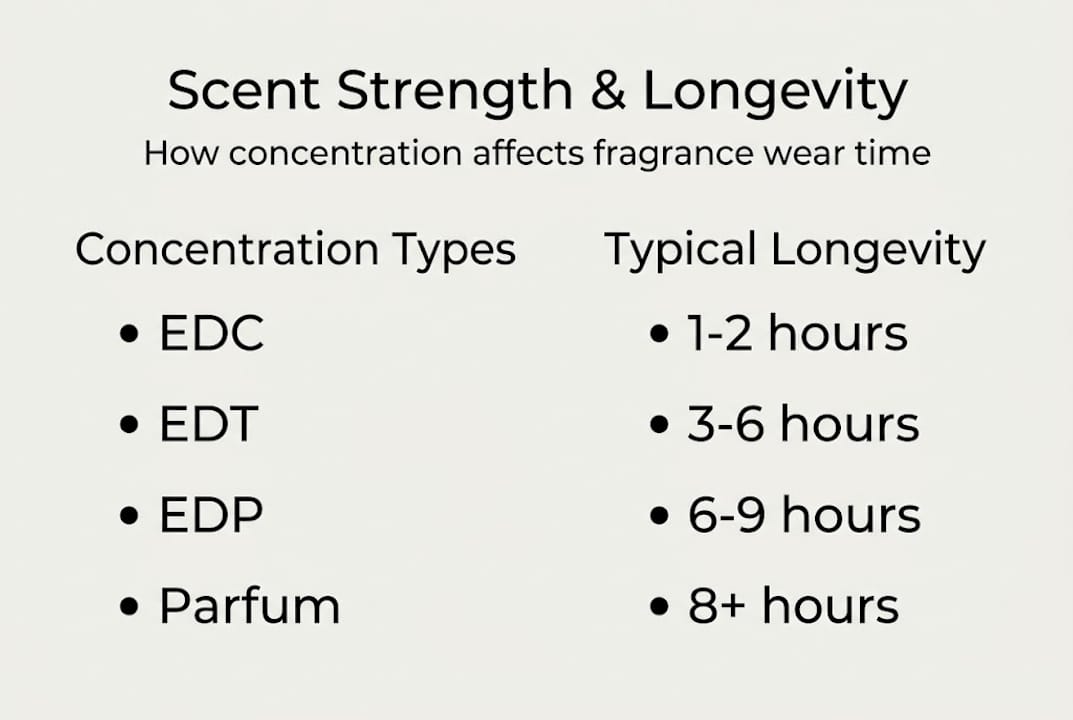
Concentration levels play a massive role in how long each stage lasts. Here's a quick reference to help you navigate labels:
| Concentration type | Oil percentage | Typical longevity |
|---|---|---|
| Eau de Cologne (EDC) | 2 to 4% | 1 to 2 hours |
| Eau de Toilette (EDT) | 5 to 15% | 2 to 4 hours |
| Eau de Parfum (EDP) | 15 to 20% | 4 to 6 hours |
| Parfum / Extrait | 20 to 40% | 6 to 12+ hours |
As research on concentration and longevity confirms, different formula concentrations yield different longevity ranges, but the relationship isn't perfectly linear. Our fragrance concentration guide goes into the practical implications in detail.
One aspect that rarely gets discussed in mainstream fragrance content is the role of fixatives. These are ingredients, often musks, resins, or woody materials, that slow the evaporation of other molecules, effectively anchoring the formula to your skin. A well-balanced formula with quality fixatives can outperform a high-concentration one that's poorly constructed. If you're curious about how these decisions are made, our piece on making perfumes gives a wonderful insight into the craft.
Pro Tip: Don't assume a higher oil percentage automatically means a longer-lasting fragrance. A perfectly balanced EDP with strong fixatives will often outlast a poorly structured Parfum.
Why longevity varies: Skin, climate, and ingredients
Now that you know how perfumes are structured, it's important to consider why longevity isn't the same for everyone, or even with the same fragrance in different situations.
Your skin chemistry is arguably the biggest factor. People with naturally oilier skin tend to retain fragrance longer because scent molecules bind to lipids on the skin's surface. Drier skin, by contrast, has less to hold onto, so molecules evaporate faster. Body heat also plays a role: warmer skin accelerates evaporation and can boost projection early on, but the scent may fade sooner overall. Even diet can subtly shift your skin's pH and alter how a formula interacts with your body. This is explored in more detail in our guide on why perfumes smell different on everyone.
Environmental conditions create substantial variation too. Heat and low humidity cause faster evaporation, which is why a fragrance that lasts all day in winter might feel fleeting during a warm summer afternoon. Cool, humid conditions slow evaporation and can actually extend wear time noticeably. Our article on fragrance and season covers this beautifully if you want to align your choices with the calendar.
Here's how performance shifts across different conditions:
| Condition | Effect on longevity | Practical implication |
|---|---|---|
| Hot and dry | Faster evaporation, shorter wear | Choose EDP or Parfum concentration |
| Cool and humid | Slower evaporation, longer wear | EDT or EDP typically sufficient |
| Oily skin | Better retention, extended wear | Lighter concentrations can perform well |
| Dry skin | Faster fade, reduced projection | Moisturise skin before application |
Ingredient quality matters enormously too. As analysis of natural versus synthetic performance confirms, natural ingredients may outperform synthetics on skin, with edge cases showing that higher concentration does not always mean longer wear.
The three most common reasons longevity disappoints in real life:
- Application to dry, unprepared skin: Scent molecules need something to bind to. Bare, dry skin offers very little.
- Rubbing the fragrance in: This physically breaks down the structure of the scent and accelerates evaporation of the top notes.
- Misjudging concentration for the climate or occasion: Wearing an EDT outdoors in midsummer is a recipe for disappointment.
Practical tips: Testing, choosing, and boosting scent longevity
So, if everything from formulas to climate impacts your experience, what can you actually do to make sure you get lasting pleasure from your fragrances?
How to test true longevity on your skin:
- Apply a single spray or dab to your wrist or inner elbow in the morning.
- Avoid testing on paper, as paper doesn't replicate skin chemistry at all.
- Check back at two hours, four hours, and six hours, noting what remains and how the character has changed.
- Wear your normal routine that day so you're testing under real conditions, not controlled ones.
- Ask someone near you what they can detect at each interval. Olfactory fatigue means you'll often stop noticing a scent long before it actually fades.
When selecting a fragrance based on longevity needs, think about your lifestyle. A professional who needs to smell fresh through long meetings might prioritise a well-constructed EDP with strong base notes. Someone who enjoys fragrance as a subtle personal pleasure might find a lighter EDT more appropriate and less overwhelming in close proximity.
Our fragrance shopping tips go into how to approach this process with confidence.
To boost performance, try these approaches:
- Moisturise skin before applying, using an unscented lotion to give the molecules something to cling to.
- Apply to pulse points like the wrists, neck, and inner elbows where body heat gently amplifies the scent throughout the day.
- Try fragrance layering by combining a matching body lotion or shower gel with your perfume to extend the base note experience.
As research into olfactory fatigue makes clear, olfactory fatigue can make a perfume seem to fade before it actually does, and skin proximity matters more than sillage when judging wear.
Pro Tip: When you feel like your fragrance has vanished, press your wrist to the inside of your elbow and take a slow breath. Chances are, the scent is still there. You've simply adapted to it.
A fresh perspective: Longevity isn't everything
Having covered ways to extend longevity, let's reconsider why you might not always want your perfume to linger endlessly.
There's a persistent idea in fragrance communities that longevity is the ultimate measure of quality. We'd gently push back on that. Some of the most beautiful fragrance experiences are the ones that burn brightly and briefly. A burst of neroli on a warm morning, a fleeting green accord that evokes the exact feeling of early spring, these moments don't need to last eight hours to leave a lasting impression.
Fragrance is fundamentally about experience and self-expression, not endurance. The way a scent evolves on your skin, shifting from sharp brightness to soft warmth over a few hours, is part of the artistry. Chasing maximum longevity can sometimes mean prioritising heavy base notes at the expense of that beautiful journey.
The emotions and memories that perfume evokes often outlast any molecular trace. A fragrance doesn't need to be present on your skin eight hours later for it to have mattered. Wear scent for the joy it brings you in the moment, and longevity becomes just one useful tool rather than the whole point.
Find your unforgettable signature with Amoure Parfums
Putting this knowledge into practice starts with having the right options in front of you. At Amoure Parfums, we've curated a collection that spans every preference, concentration, and longevity profile so you can find what genuinely works for your skin, lifestyle, and taste.
Whether you're drawn to a bold, long-wearing EDP for evening occasions or a fresh, lighter scent for everyday wear, our full fragrance collection makes it easy to explore. Browse by category, read the detailed note breakdowns, and discover options that match your longevity expectations. From our women's fragrances to a carefully selected range of men's fragrances, there's a signature scent waiting for you in 2026.
Frequently asked questions
How can I make my perfume last longer?
Apply to moisturised skin, focus on pulse points, and consider layering similar scents for extra longevity. As skin preparation and layering research confirms, these techniques meaningfully extend scent duration.
Why does my fragrance fade so quickly on my skin?
Factors like skin type, body heat, humidity, and the specific notes and concentration all affect how long a fragrance lasts for you. Longevity varies significantly with skin chemistry, environment, and formula composition.
Is higher concentration always better for longevity?
Not always. A balanced formula with the right fixatives and quality ingredients can last longer than one with simply a high oil percentage. Higher concentration doesn't guarantee greater longevity in every case.
What is the difference between longevity, sillage, and projection?
Longevity measures how long a scent lasts on skin, while sillage and projection describe the distance your scent radiates from your body. Skin-close longevity is a distinctly separate measure from how far a fragrance travels through the air.